





-
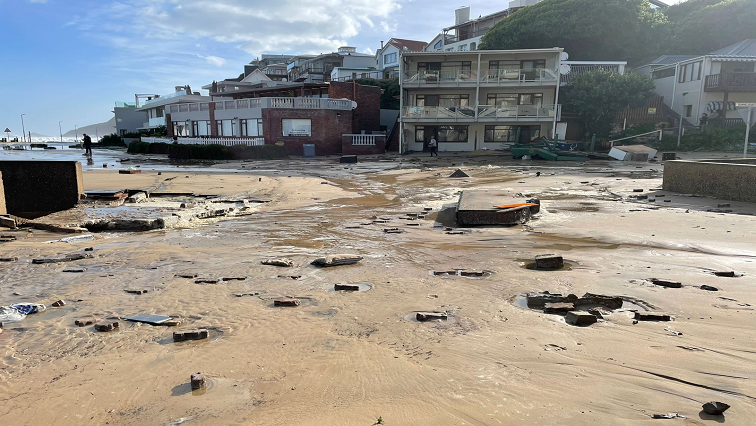
Home and businesses affected by a storm surge in the Western Cape.
Western Cape Premier Alan Winde says the provincial government will request another disaster classification from the national government following severe storms that caused widespread damage across the province last week.
The storms damaged road networks, water infrastructure and electricity systems in several areas. Eleven people also died during the severe weather conditions.
The latest request follows an earlier national disaster classification affecting several provinces, including the Western Cape, after severe weather caused extensive damage across parts of the southern Cape two weeks ago.
Winde briefed the media in Cape Town on Monday and said the province may not have sufficient funding to deal with the scale of the damage.
Winde said, “I’m pretty sure that we won’t have enough money for this. Last time we had nearly a billion rands worth of damage. We got back 300 million out of the 890 billion that it cost us. So Minister Hlabisa is coming on Wednesday, so we will engage with him. We’ve got two disasters in one year, we have to get a second classification and we will be engaging with the national Government to see what support we can get.”
In South Africa, disaster classification is governed by the Disaster Management Act and managed through the National Disaster Management Centre.
The classification process determines whether a disaster should be managed at the municipal, provincial or national level, depending on the extent of the damage and the resources required.
A disaster declaration allows government departments to redirect budgets, access disaster relief funding and implement emergency measures to support recovery operations.
The Western Cape government says engagements with national authorities are expected to continue as damage assessments are finalised across affected areas.
VIDEO | Western Cape focuses on disaster relief:
N1 remains OPEN between Worcester and Paarl.
Night alert: One lane open in each direction at Du Kloof Lodge north of the tunnel. Run-off water is crossing the southbound carriageway. Drive carefully.
Hazmat vehicles must use Du Toitskloof Pass. No hazmat in the Huguenot Tunnel. pic.twitter.com/OHHywQ10C8
— Premier Alan Winde (@alanwinde) May 14, 2026
How Disaster Classification Works in South Africa
According to the Department of Cooperative Governance and Traditional Affairs (CoGTA) and the National Disaster Management Centre (NDMC), a disaster classification in South Africa is governed by the National Disaster Management Centre under the Disaster Management Act 57 of 2002.
The process is divided into two stages: classification and declaration.
Classification is a technical assessment used to determine the scale of a disaster and which sphere of government is responsible for managing it.
A local disaster is handled at municipal level when the municipality has sufficient resources to respond.
A provincial disaster is declared when the impact exceeds the capacity of one municipality or affects multiple municipalities within a province.
A national disaster applies when provincial and local governments cannot manage the disaster adequately, or when several provinces are severely affected.
Once a disaster is classified and a State of Disaster is declared, government departments can redirect budgets and access emergency disaster funding.
The declaration also gives authorities emergency powers to issue directives, mobilise resources and coordinate responses, including the possible deployment of the South African National Defence Force.
Official disaster classifications and declarations are published through the Government Printing Works and the South African government news platforms.
VIDEO | Western Cape picking up the pieces after devastating storms: