-
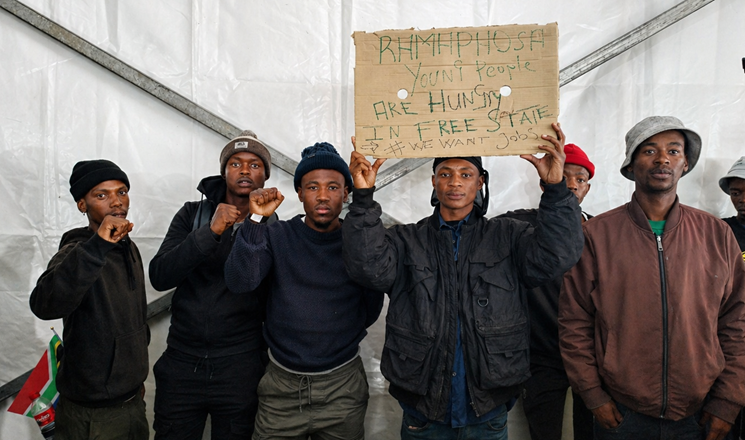
A group of young men with one holding up a sign which reads “Ramaphosa, Young People are hungry in the Free State…”
At the back of the tent, away from the main stage where President Cyril Ramaphosa addressed thousands gathered for Freedom Day in Bloemfontein, a group of about seven young men stood quietly, rotating a single placard among themselves.
“Ramaphosa, Young People are hungry in the Free State,” it read.
The message did not interrupt the proceedings, but it lingered.
In a celebration marking more than 30 years of democracy, it pointed to a different kind of reality — one that continues to shape the lives of many young South Africans.
Freedom Day commemorates the country’s first democratic elections in 1994, a moment that marked the end of apartheid and the beginning of constitutional democracy.
This year’s event, hosted at the Dr Rantlai Molemela Stadium in Bloemfontein, carried the theme of democratic citizenship and the rule of law.
But outside the speeches and official programme, the conversation was already happening.
The placard, with the hashtag #wewantjobs, reflects a broader national concern.
According to Statistics South Africa, the country’s unemployment rate stood at 31.4% in the fourth quarter of 2025, with about 7.8 million people unemployed. When including discouraged work-seekers, the expanded unemployment rate rises to above 40%.
In the Free State, the situation is more difficult. Provincial figures show unemployment fluctuating between 36.2% and 37.2% across 2025, placing it consistently above the national average.
“Unemployment in the Free State cannot be allowed to persist at crisis levels,” said MaQueen Letsoha-Mathae during her State of the Province Address.
She acknowledged both movement and stagnation in the numbers.
“The unemployment crisis, deeply rooted in historical inequalities and worsened by economic pressures, continues to affect thousands of households across the province,” she said.
“The official unemployment rate in the Free State fell from 38.5% in the second quarter of 2025 to 36.2% in the third quarter, a commendable 2.3 percentage point drop. For the fourth quarter, we now sit at 37.2%. While this is worrying, we are working extraordinarily hard to turn the tide against unemployment”, she adds.
Young people in Bloemfontein at Dr Rantlai Molemela Stadium hold up a placard which says “Ramaphosa young people are hungry in the Free State…”
“We want Jobs…” during the Freedom Day Celebrations. #sabcnews #freedomday pic.twitter.com/G4FgcwUpGe— Okuhle Magcaba (@OMagcaba) April 27, 2026
Government interventions have focused on public works and sector development. In 2025, the province reported creating over 46,000 opportunities through the Expanded Public Works Programme, with a target of more than 44,000 set for 2026. Agriculture and solar energy have been identified as key growth sectors.
But for some young people in Mangaung, these interventions have not translated into long-term change.
“What brings us here is that we know that the President today will be with us, celebrating freedom. And yet we, the young people of Mangaung, we still feel that we are not free yet enough,” said Tiisetso Mokehlane, one of the young men at the event.
He says the group represents a mix of unemployed youth and small business owners seeking investment.
“We want young people to get better opportunities, not these short-term employment jobs that are created for young people”
Mokehlane says efforts to engage with local government have yielded limited results.
“We have one addressed it with the counsellor… we went further, even to apply and submit FDC (Free State Corporation)… we have a portfolio of evidence of our work… unfortunately, due to reluctance or slow response in the Government.”
Beyond employment, he points to social consequences.
“Lack of government support, Mangaung faces a high drug rate, crystal meth, young people are joining these gangsters as well due to the unemployment rate, young people don’t know where to fall or where to run…”
The contrast between the official programme and the protest was not confrontational, but it was visible. On one side, a celebration of democratic progress; on the other, a reminder of its uneven outcomes.
South Africa’s democratic framework, built over the past three decades, remains intact. Institutions continue to function, elections are held regularly, and rights are protected in law. But the question of economic inclusion, particularly for young people, continues to shape how freedom is experienced.
In Bloemfontein, on a day meant for reflection, that question did not need a microphone. It was written on cardboard, passed from one hand to another, and held up just long enough to be seen.
Free State targets unemployment reduction