




-
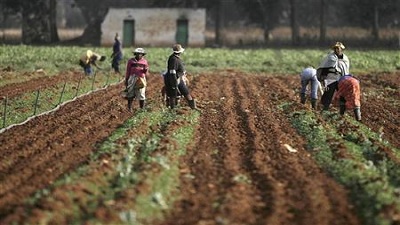
Farmworkers are seen at a farm in Eikeihof outside Johannesburg September 30, 2008.
As South Africa commemorates Workers’ Day, some farm workers in Limpopo are raising concerns about illegal evictions, landlessness, and insecure tenure on farms.
Some say they still experience discrimination by farm owners.
They are also lamenting poor living conditions and unfair treatment.
One of them is Fifty-one-year-old Maesela Lekolwane from Ga- Rakgwatha in Zebediela. He is the breadwinner for a family of five.
He started working on various farms in 2021. He says he was puzzled that even in the democratic dispensation, he and his co-workers are still subjected to what he calls racially- charged prejudices.
Lekolwane says, “When I first started working over five years ago, there were still racial issues where white people had their own toilets and blacks had their own. where black people would never sit in the front of the vehicle with white people. Although those were sorted, now we have a challenge about housing where white people live in houses with their families, but as black people are not allowed to have our families visit for more than three days in the one-room houses that we live in.”
The Food Allied Workers’ Union says farm workers are protected by various laws such as the Basic Conditions of Employment Act, the Labour Relations Act, the Employment Equity Act and the Occupational Health and Safety Act.
They are also covered by the national minimum wage, with the minimum rate set at 30 rand and 23 cents per hour.
FAWU says this milestone means farm owners will no longer use their discretion to pay farm workers. However, FAWU says these gains are marred by some persisting challenges.
FAWU deputy general secretary Edwin Mabowa says, “You can recall that farm workers were paid at the discretion of farmers, which was a detriment to all of them. Now, in this case, although we are not saying the national minimum wage is a living wage, we are saying it is better, as increases are also significant and are closing the gap quickly. On the contrary, we still have farmers operating like during apartheid years, like farmers who are not complying with the labour statutes that I mentioned, we have farm owners who are deducting pension fund contributions and not paying to service providers. We have farm workers who are still violating the tenure act that is supposed to address illegal evictions.”
The Human Rights Commission says it is still getting complaints of unfair labour practices in spite of all the regulations to protect workers.
Victor Mavhidula from the HRC says, “Most of the cases that we receive are related to eviction of the farm workers and eviction of farm dwellers and dismissals of the farm workers without following the right procedures. Sometimes evictions are taking place without a court order, and in most cases, you find that the farm owner will just decide to cut the water supply and electricity for the farm dwellers. Sometimes you find that these farm workers are being abused and assaulted. Some of them are being murdered with no trace.
The commission has admitted that they have not yet scratched the surface in terms of educating farm workers about their rights at the workplace.
Edwin Mabowa of FAWU says, “You can recall that farm workers were paid at the discretion of farmers, which was a detriment to all of them. Now, in this case, although we are not saying the national minimum wage is a living wage, we are saying it is better, as increases are also significant and are closing the gap quickly. On the contrary, we still have farmers operating like during apartheid years, like farmers who are not complying with the labour statutes that I mentioned, we have farm owners who are deducting pension fund contributions and not paying to service providers. We have farm workers who are still violating the tenure act that is supposed to address illegal evictions.”
Mavhidula on the other hand says,” it is unfortunate that we have not reached out to every farm worker or every farm in the province simply because some of them farm workers they are residing just straight inside the farm wherethe human rights commission might not even know that people are staying in this farm and might not even know who to engage to reach out to them and provide them with the education on how they can protect their rights or how they can report abuse by farm owners.”
The Human Rights Commission has vowed to heighten efforts by collaborating with labour unions to ensure that business operations implement labour laws.
Video | Workers’ Day 2026 | Farm workers lament exploitation and racial discrimination