

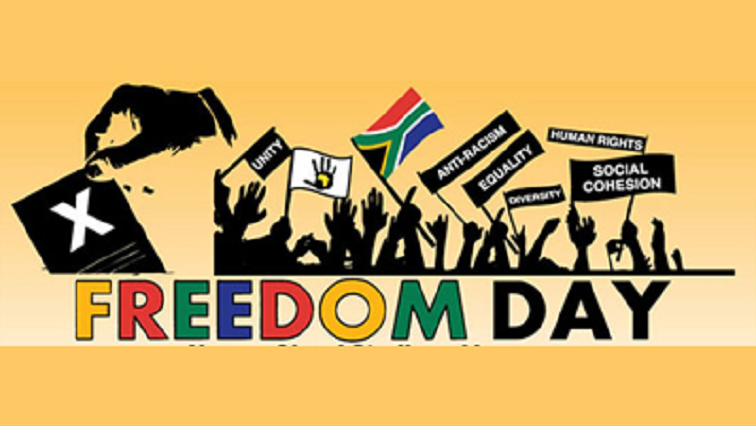
South Africa marks Freedom Day on 27 April, commemorating more than three decades since the country’s first democratic elections in 1994.
This year’s observance takes place under the theme: “Freedom and the Rule of Law: Thirty Years of Democratic Citizenship”, with national celebrations set to be held in Bloemfontein in the Free State.
Freedom Day remains tied to the moment when millions of South Africans voted for the first time in a democratic election, marking the formal end of apartheid. Nearly 20 million people participated in that vote, which led to the formation of a Government of National Unity under Nelson Mandela.
This year’s commemoration aligns with several historical milestones, including 70 years since the 1956 Women’s March, 50 years since the 1976 Soweto Uprising, and 30 years since both the adoption of the Constitution and the start of the Truth and Reconciliation Commission hearings.
President Cyril Ramaphosa is expected to deliver the keynote address, with government emphasising the role of democracy, human rights and the rule of law in shaping the country’s future.
Beyond the official programme, the meaning of Freedom Day continues to be shaped by the country’s lived realities. South Africa faces ongoing challenges, including unemployment, inequality and crime. Recent data shows that more than 7 million people remain unemployed, reflecting structural pressures in the economy.
Issues of governance and accountability also remain in focus, with corruption and service delivery failures affecting communities. At the same time, many apartheid-era cases remain unresolved, with families still seeking justice decades after the Truth and Reconciliation Commission processes began.
Political shifts have added another layer to the current moment. Following the 2024 elections, a Government of National Unity was formed, bringing together multiple parties after the African National Congress lost its majority for the first time since 1994.
Freedom, as an idea, continues to be debated and defined. Anti-apartheid activist Steve Biko once said, “The most potent weapon in the hands of the oppressor is the mind of the oppressed.” The statement has often been linked to the broader understanding of freedom as both political and psychological.
Pan Africanist Congress founder Robert Sobukwe also spoke to the idea of freedom, stating, “We aim, politically, at government of the Africans by the Africans for the Africans, with everybody who owes his only loyalty to Africa and who is prepared to accept the democratic rule of an African majority being regarded as an African.”
As South Africa marks Freedom Day, the focus remains on balancing reflection with current realities. The day continues to recognise the country’s democratic transition, while highlighting the ongoing work required to address inequality, strengthen institutions and expand access to opportunity.
President @CyrilRamaphosa will on Monday, 27 April 2026, lead the national #FreedomDay Commemoration to be held in the Mangaung Metropolitan Municipality in Bloemfontein, Free State Province https://t.co/jJoMLRUSal#FreedomDay2026 #AWorkingNation #ANationThatWorksForAll pic.twitter.com/SEFzI5s7yn
— The Presidency 🇿🇦 (@PresidencyZA) April 25, 2026