




-
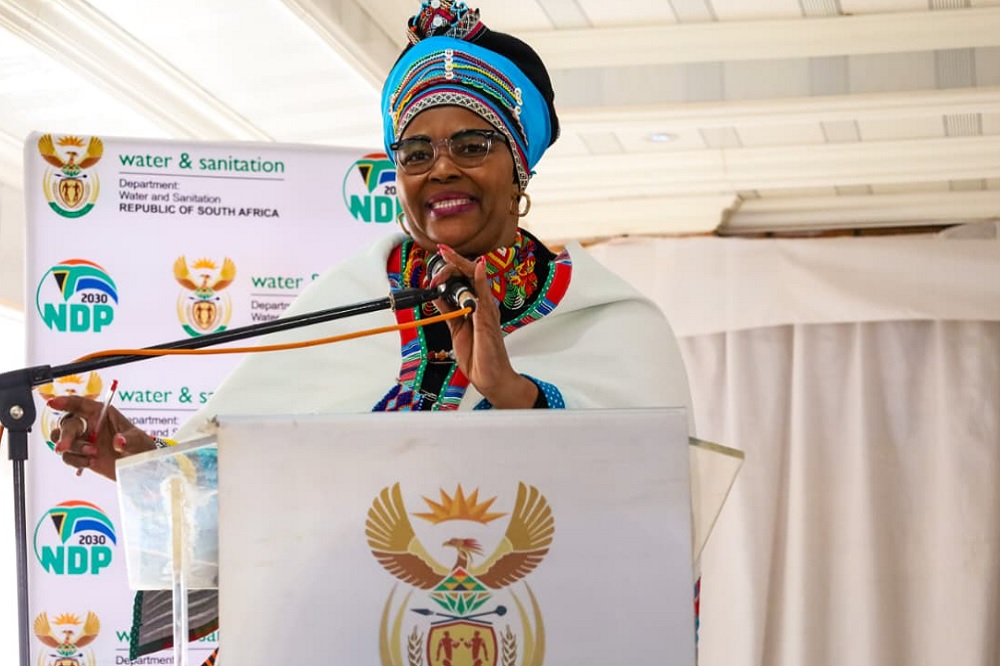
Minister of Water and Sanitation, Pemmy Majodina speaking at the Nden’eza village outside Giyani.
Minister of Water and Sanitation Pemmy Majodina says the department will review all bulk water user licences to ensure compliance with water regulations.
This follows findings from an independent investigation which revealed that a group of commercial farmers have allegedly blocked the flow of water to communities around the N’wamanungu Dam, formerly known as the Middle Letaba Dam, in Limpopo.
Majodina addressed community members during a meeting held at Nden’eza village outside Giyani.
The N’wamanungu Dam has not been full in over two decades.
The report investigated persistent water shortages in the area. It was conducted by an Independent Ministerial Investigative Panel commissioned by the Water and Sanitation Department in 2024.
The findings contained in the lengthy report have revealed failures by the department in ensuring that areas around the dam’s catchment areas are unaffected by water shortages.
Majodina says a group commercial farmers situated upstream were the main cause for low water levels at the dam.
“Amongst other things that are the findings is that there are dams upstream that take a lot of water hence the Letaba Dam was not filling up. Secondly, there are certain farmers who abstract more than their license allow them to do so and that inconveniences people in the downstream. The third one, there are illegal connections mainly caused by illegal dams that have also been constructed around the area.”
The department has further admitted that it did not properly regulate water use licenses of commercial farmers implicated in the report.
Minister Majodina says that upstream farming activity where rivers such as the Kudu supply water, prevented the flow of water to communities further down.
“ We are going to visit each and every license and check it’s capacity in terms of its authority to abstract, but if they are over abstracting, we are going to reduce that. Whilst we appreciate irrigation, it must not be at the expense of other people. Let all users of water get water and we are going to do equitable sharing of that water. Do irrigation but allow livelihoods to have water for their day-to-day activities.”
Residents in the Giyani area have welcomed the findings. However, they have demanded that authorities provide a detailed plan regarding water provision.
“ We welcome the report, yes, but we think there are a lot of grey areas on the report because we know the action plan and what needs to be done where, but then there is no time frame on when these things are supposed to be done,” says one of the residents.
The Water and Sanitation Department has promised to review its plans every three months to finally supply uninterrupted water to communities in the area.
Following the release of the report a community engagement was held to brief various stakeholders including traditional leadership of Ndengeza Tribal Authority in Giyani, about the Ministerial Independent Investigative Panel Report released. pic.twitter.com/UdgAr50mfE
— Water&SanitationRSA (@DWS_RSA) May 13, 2026