



-
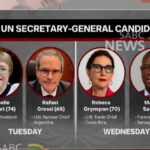
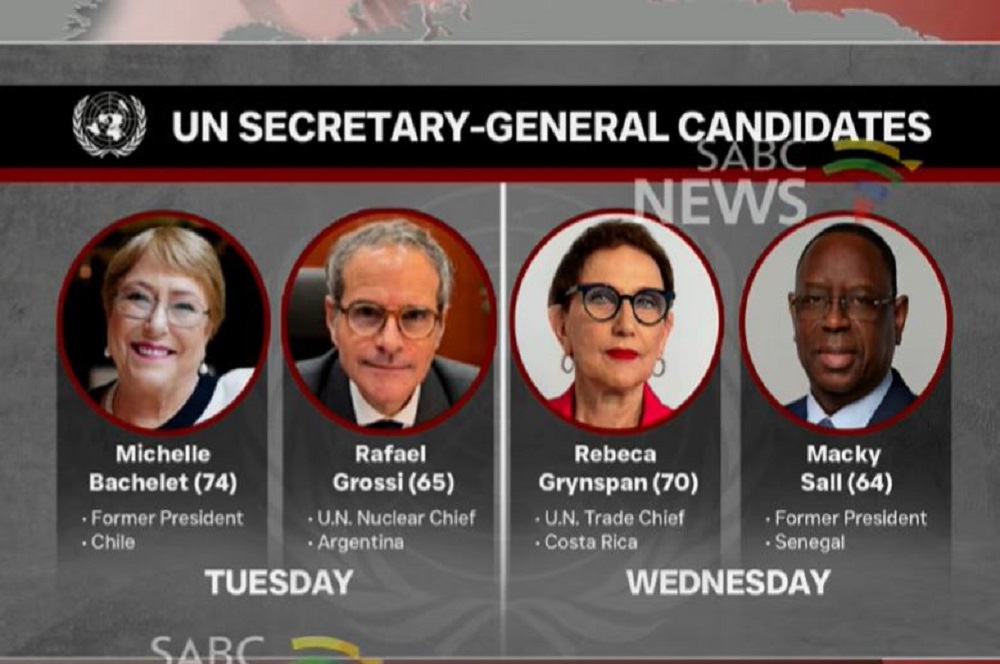
An infographic of the four candidates for the position of the UN Secretary-General.
Four candidates for the position of United Nations Secretary-General will participate in interactive dialogues with member states and civil society starting Tuesday as efforts to select the organisation’s first female leader ramp up.
The dialogues were first introduced during the selection of the last UN Chief in 2016, allowing candidates to present their visions for the organisation amidst efforts to make the process more open and transparent.
The next Secretary-General will replace incumbent Antonio Guterres, whose second and final five-year term ends on December 31st.
The selection of the world’s top diplomat moves into the next phase this week, and a process unfolding at a time of huge disruption and mounting criticism that the global organisation is increasingly sidelined on the major geopolitical questions of the day; in large part due to an ineffective Security Council and its aging composition that continues to be a drag on the entire U.N. system.
Mathu Joyini the former SA ambassador to U.N. had this to say, “According to the charter, the General Assembly is responsible for the appointment of the new SG or of the Secretary-General at the recommendation of the Security Council. So it’s the appointing authority, but the Security Council makes the recommendation. So, of course, the General Assembly has to think carefully about the process that it wants in the selection and appointment process. And so it and then codify it. So every time there’s a there’s a selection of the SG, there is a resolution that codifies how the process should unfold.”
The process in this cycle prefers candidates from the Latin America and Caribbean Group, but not limited to that region.
Michelle Bachelet, the first female President of Chile serving two non-consecutive terms, a former U.N. High Commissioner for Human Rights and the first Executive Director of UNWOMEN, nominated by Brazil and Mexico.
Rafael Grossi, the current Director General of the International Atomic Energy Agency and a former Argentine diplomat as Ambassador to Austria and International Organisations based in Vienna, nominated by Argentina
Rebeca Grynspan, a former First Vice President of Costa Rica and long time UN bureaucrat who has served in various roles across the system including as the current Secretary-General of the U.N. Conference on Trade and Development – nominated by Costa Rica
Finally, Macky Sall, Senegal’s former two-term President and former Prime Minister, nominated by Burundi.
In her former role as South Africa’s Ambassador, Joyini co-faciliated the procedural framework along with Romania for selecting the next SG.
“We are sitting with four candidates right now, and many will point out that in 2015, 2016, you in 2016, you were looking at about nine candidates, at this point in time. So, I think there’s a number of factors. One, it talks to the complexity of the moment that you are in now, just understanding the dynamics and the dynamics in the Security Council. I think most candidates would want to get a feel for… because the P5, remember, do have a veto on this process. So, they want to get a signaling around how the P5 will act.”
Asked about the stature and character of the person best suited for a position often described as more Secretary and less General, Joyini weighed in.
“I really think it’s both. And I think it’s on the incumbent to realize the moment and to seize the moment, and know when the moment is about the ‘general’. So, definitely, you need both the general and the secretary, and I think the secretary is about administering the entity, the UN, right now, you need somebody who’s going to do much, much more than just administering this entity.”
The push for the next U.N. leader to be a woman has gathered steam.
President of UN General Assembly Annalena Baerbock, says, “This next Secretary-General should provide strong and dedicated, effective leadership skills with experience in governance structures, but also with regard to United Nations, with regard to management skills of this institution in the light of the reforms. And then, it has also the strong call with regard to regional diversity and this call, in consensus by 193 member states to strongly, call on member states for the nomination of women.”
Mathu has noted, “We made a call and member states wanted in that resolution for countries to nominate female candidates. And we started with using the language deploring and the left deploring the fact that there has never been is a female Secretary-General. Of course, the negotiations were tough and we had to move from deploring to strongly encouraging member states to nominate female candidates. And I think a majority, we really would like to see us move in that direction.”
A process likely to only conclude in the last quarter of 2026 as this week’s interactive dialogues take centre stage.
U.N. Secretary General Antonio Guterres address the media