





-
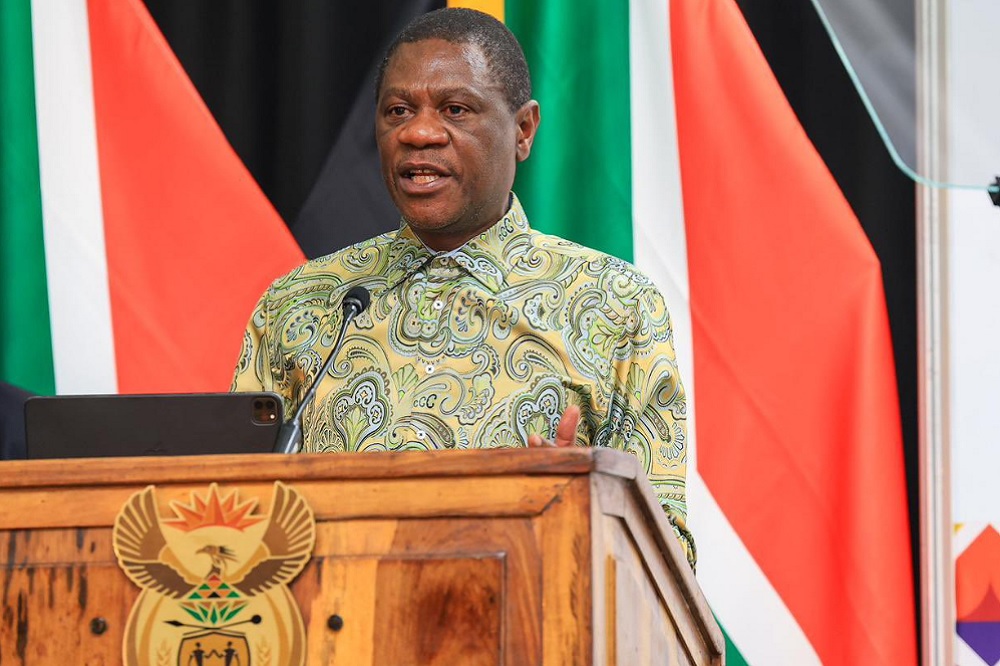
Deputy Minister Paul Mashatile addresses the 5th Human Resource Development Council at the Gallagher Convention Centre in Midrand.
Deputy President Paul Mashatile has emphasised the importance of ensuring that the country’s human resource development system remains responsive to rapid technological change, including artificial intelligence, digitalisation and automation.
Delivering an opening address at the 5th Human Resource Development Council (HRDC) Summit at the Gallagher Convention Centre in Midrand, Mashatile stressed the need for preparing young people and workers for the jobs of the future.
Mashatile emphasised that the push for skills development, employability, and state capability requires deep social compacts grounded in trust, accountability, and shared ownership. He pointed out that the HRDC Summit coincides with the launch of the Reconceptualised Human Resource Development Strategy for the period 2025 to 2035, as well the Master Skills Plan.
“Guided by the National Development Plan, the reconceptualised strategy identifies four goals and 12 interventions across the HRDC’s three thematic areas. In schooling, these include early childhood development, reading for meaning, and curriculum differentiation, each requiring deep collaboration. In youth development, the emphasis falls on relevant short courses and expanded workplace experience, particularly within growth sectors such as the green and digital economies and scaling technology, drive skills programmes.”
Allow me at this stage to formally recognise the members of the newly appointed HRD Council, who will be the custodians of this strategy. This Council represents all constituencies, and we have already witnessed their collaborative efforts to enhance human resource development in… pic.twitter.com/vkpskVHofG
— Paul Mashatile🇿🇦 (@PMashatile) April 16, 2026
Today, success in a dynamic and uncertain world increasingly depends on human and social capabilities such as analytical thinking, communication, creativity, collaboration, resilience, and adaptability.
Automation and AI are transforming industries at a speed that often exceeds… pic.twitter.com/W02L5IWGwQ
— Paul Mashatile🇿🇦 (@PMashatile) April 16, 2026
Mashatile says as artificial intelligence and automation transform industries, emphasis should be made on developing human-centred and social skills.
“Today, success in a dynamic and uncertain world increasingly depends on human and social capabilities such as analytical thinking, communication, creativity, collaboration, resilience, and adaptability,” says Mashatile.
Minister of Higher Education and Training Buti Manamela says all stakeholders including government, civil society, labour and business must share the responsibility of advancing skills development and employment in the country.
“There are TVET colleges that are not yet trustees, SETAs that are not performing, qualifications frameworks that are not yet responsive. These sit in government’s house that accountability sits with us, and we must accept it. To organised business, our youth unemployment crisis is not just a social problem that business can observe from a distance. It is a structural feature of the economy that is not absorbing people it educates. The skills development levy you pay, the workplaces you control, the hiring decisions you make, these are the instrument gaps that either close the gap or leave it open.”