


-
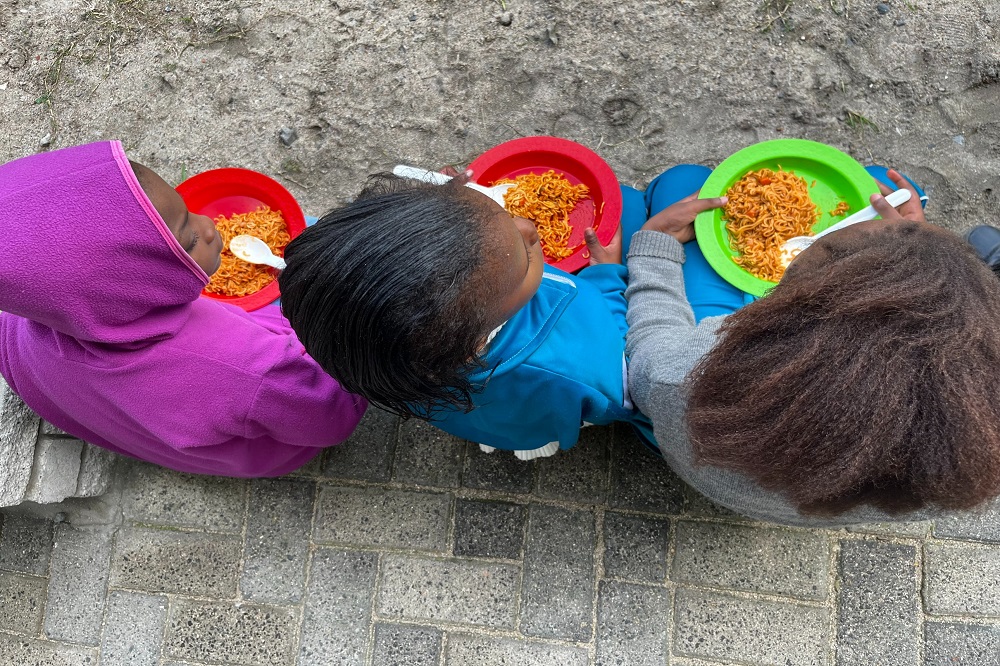
Children seen having a meal.
South Africa’s largest food redistribution non-profit organisation, FoodForward SA Foundation, has warned that urgent action is needed to address the deepening hunger crisis in the country, with millions of households being food insecure.
A comprehensive survey by the organisation, in conjunction with a research unit of the University of Cape Town, found that seven out of ten households in the country experienced moderate to severe food insecurity, while almost one in four go a day without food.
The report, titled: ‘The state of Household Food Insecurity in South Africa‘, focused on close to 800 individuals in households who already receive food aid and showed that hunger has become widespread, entrenched and unstoppable.
And more concerning is the growing number of children suffering from hunger and malnutrition.
Statistics South Africa data showed that 18 million South Africans were food insecure in 2023, while severe food insecurity rose from 5 million in 2019 to 8 million in 2023
For millions of South Africans, coping with less food or skipping meals has become a reality.
This mother, who looks after her daughter’s two-year-old son, says life is very difficult.
She says she often doesn’t have enough food to eat.
She says she had a job last year but lost it however and she didn’t qualify for the social relief of distress grant. She says her grandson’s child grant goes to her daughter who is studying at a college, but who hasn’t received funding.
PODCAST | New study reveals deepening food insecurity crisis in South Africa
She’s one of a few mothers whose children receive one daily nutritious meal from a local non-profit organisation, which feeds close to 300 children with the help of FoodForward SA.
Some of these younger pre-school children might eat only twice a day. The majority of beneficiaries are primary schoolchildren, who’ll arrive after school.
They would have at least eaten a meal provided by the school. But it’s tough during school holidays.
Mandisa Dlamini of the Gugu Dlamini Foundation says, “Especially during the holiday season, that’s when we see a high number of kids coming for the FoodForward programme because the only meal they are getting is the one from here, unlike when they get the meals from school when the schools are still open. We’ve seen a high number of volumes in terms of kids coming for the food programme and not only the kids from this community, but evening neighbouring wards where you’re looking at 4/5 km distance from school to here back to home.”
Dlamini says there are days when there’s not enough to meet the demand. On those days, the meals are shared.
Related video| HSRC survey shows widespread food insecurity in SA:
https://www.youtube.com/watch?v=w7J3C8gAWHc
Similarly, FoodForward SA’s Andy Du Plessis says they can clearly see the hotspots.
“Limpopo, Eastern Cape, North West, Mpumalanga, and we can see that children are the worst-affected, parents are finding it increasingly difficult to explain to children that there is only a little food to eat, or tonight you are going to go without food, smaller meal sizes and sometimes skip food,” says Du Plessis.
The mothers say they struggle to make ends meet. Grants are spent on rent, food, school uniforms and transport. It’s never enough.
Du Plessis further adds, “The research shows two drivers: gross inequality, historical inequality, the second is high unemployment and the third reason is food prices are going through the roof, and affordability is a major deterrent for people. The Stats SA says 18 million people are food insecure. We say it’s close to 25 million people who are insecure.”
He called on government to prioritise budgets on addressing nutrition and food insecurity.
And says organisations such as Foodforward SA, and community kitchens should be supported as they’re already assisting.
The organisation has long campaigned for distributing surplus food – good for human consumption – from farmers, retailers, and manufacturers, to address the problem of food insecurity and nutrition at scale.
Related video| There’s a lack of government intervention – Alan Browde shares more