





-
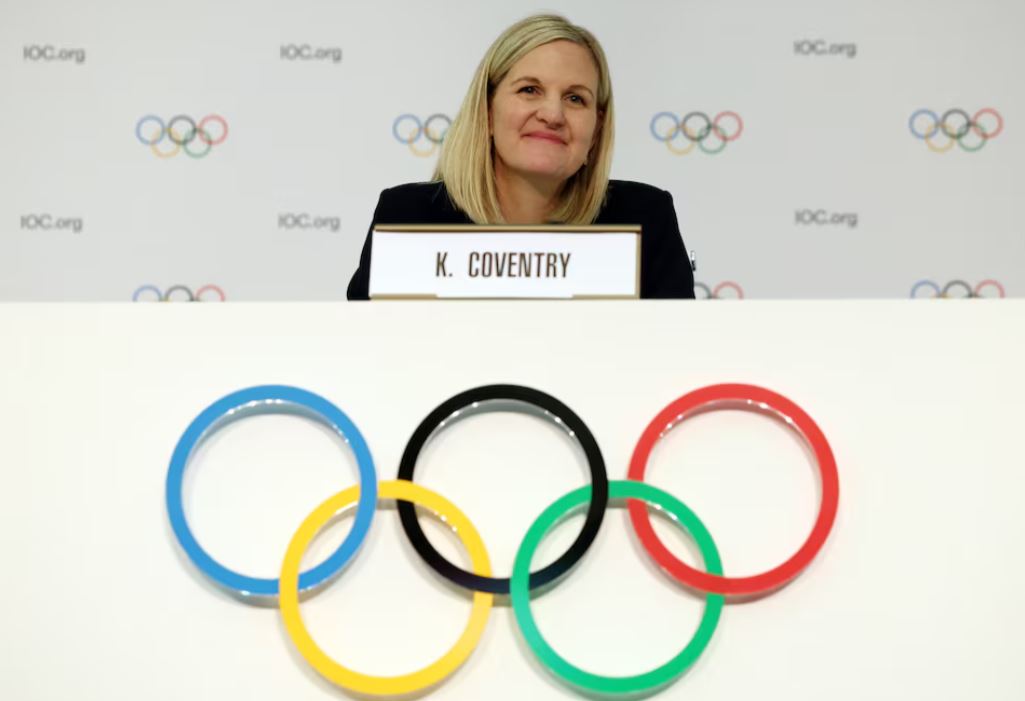
Kirsty Coventry during the press conference after she was elected as the new president of the International Olympic Committee (IOC) at 144th IOC Session in Costa Navarino, Pylos, Greece on March 20, 2025.
The International Olympic Committee (IOC) has announced a new Policy on the Protection of the Female Category in Olympic Sport and Guiding Considerations for International Federations and Sports Governing Bodies.
Reactions to the IOC’s new policy on gender testing were sharply divided, with supporters hailing the long‑overdue move to protect women’s sport, while critics maintain there is no evidence that women athletes who had undergone hormone therapy for one to three years have any sustained physical advantage.
The committee announced that from now on, athletes who want to take part in female category events at Olympic Games will be subjected to one-time gene-screening tests to determine their eligibility.
The move represents a significant reversal in sports policy at an organisation that has for years grappled with evolving approaches to the so-called verification of womanhood.
From the early 2000s up through the Tokyo Games, the IOC has maintained evolving guidelines on the participation of transgender athletes.
In 2021, the body released a set of inclusive guidelines on trans athlete participation but left decision making up to individual sport governing bodies.
Many of them banned transgender women outright and only a handful of openly transgender athletes have taken part in the Games since.
Now, all athletes who hope to compete in the women’s category from the Los Angeles 2028 Olympics onwards, will have to submit to a one-time genetic screening which will be done via saliva, cheek swab or blood sample.
IOC President Kirsty Coventry says the policy is in the best interest of female athletes.
Coventry says, “I really believe that this policy is foundationally based in science and has been led by medical experts, and it’s been done with the best interests of athletes right at the heart.”
“We know that this topic is sensitive and we hope that you’ve all seen the policy and we hope that you can read the policy, knowing and understanding that we have taken into consideration all of our stakeholders from around the world, all the multiple views, and been able to put together a policy that we can stand firmly behind with the emphasis of ensuring that athletes are looked after, that athletes have the ability to compete on a fair and level playing field. and that is what I believe we have done.”
However, Humans for Sport founder Dr Payoshni Mitra says the IOC succumbed to political pressure and warned against stigmatisation.
Mitra says, “I think it’s a safeguarding disaster. I would like to talk about the problematic part of it, it’s not science-based, it’s stigma-based, it’s more, I think, under political pressure rather than really what is required in women’s sport, but I was surprised and shocked to see is how it includes, and in fact, promotes, testing of young girls, minor athletes, child athletes and asking national bodies to do that.”
PAST INJUSTICES
Fair Play for Women Advocate Fiona McAnena has welcomed the announcement but criticised the IOC’s decision not to backdate the rules, saying it failed to address past injustices.
McAnena says, “it’s extremely welcome, it’s been a long time coming, women’s sport can only be for those who are female and the IOC sets the standard for sport worldwide. It was their policy that led all kinds of governing bodies at all levels, not just international and elite levels, but all the way down to where the majority of sport is played.”
She says, “It was the IOC that influenced letting people who are males who identify as female into the female category. So it’s very welcome that the IOC has recognised that the only way to have fair sport for women and girls is to have a protected female category, and their policy is called ‘protecting the female category’, and that’s wonderful to see.”
The new rules have no retroactive power and no impact on grassroots or amateur sports.