



-
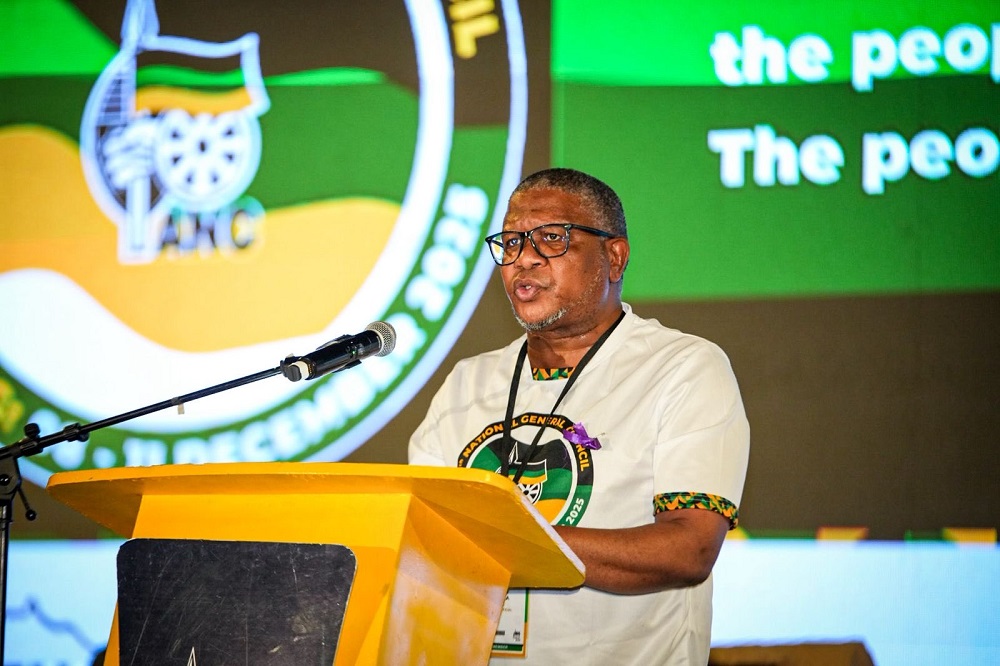
Fikile Mbalula delivering the ANC National General Council Midterm Report in Bokburg.
The African National Congress’s (ANC) Mid-term report, delivered by Secretary General Fikile Mbalula, paints a grim picture of the party’s current state.
Around 2000 delegates have gathered at the Birchwood Hotel for the party’s National General Council (NGC), which is reviewing its performance, policies, as well as the state of the organisation – two years after the 55th National Conference in December 2022.
Mbalula was not mincing his words with regards to the state of the party after thirty years of democracy. He says the party has accumulated deep internal weaknesses.
“This includes declining organisational discipline, functionalism driven by access to resources rather than ideological contestation, the entrenchment of patronage networks, widespread corruption, weakened grassroots structures, and growing distance between leaders and communities. Renewal, comrades, is therefore no longer optional. It is an existential imperative for the survival of the organisation and the continuation of the national democratic revolution,” says Mbalula.
Video | Mbalula paints A grim picture of the party:
ANC Foundation course
Amongst the interventions undertaken since the party’s National Conference in December 2022 is the introduction of the ANC Foundation course, which was formally launched in October 2024.
The political education program seeks to ensure that all ANC members understand the organisation’s history, mission, values, revolutionary morality, constitution and the contemporary national and global context.
Mbalula says the renewal of branches – the primary structure of the organisation is central to the organisation’s revival, saying that over time, many branches become functional only during leadership contests and conference periods.
“To address this, the branch functionality parameter was developed and piloted in 2023. By the time of the NGC, more than 860 branches had completed (8:35) the audit, although participation varied significantly across provinces. The parameter is intended to entrench a culture of routine reporting, community engagement and constitutional (8:48) compliance, thereby breaking the cycle of conference branches,” adds Mbalula.
Related video | It’s Day 2 of ANC 5th NGC – A look at points in political report:
Integrity Commission
The ANC’s Secretary General has also highlighted the need to strengthen the party’s consequence management framework, citing insights of the Integrity Commission.
“The Commission emphasises the distinction between disciplinary, legal, and integrity processes. Integrity operates at a higher moral threshold than criminal law. The reliance on innocent until proven guilty as a shield against ethical accountability has damaged the ANC and must be treated as misconduct,” says Mbalula.
The destructive effect of money politics was also raised, with the party’s leadership urged to tighten fundraising rules and enforce disciplinary action for violations. Looking ahead to the 2026 local government elections, Mbalula says, “The ANC has adopted a renewed four-phase strategy focused on rebuilding structures, deploying full-time coordinators, training over 200 000 volunteers, rebuilding branches, registering 4.5 million first-time voters and reactivating abstaining supporters. Success depends on five key factors. A functional election machine, improved public mood, visible service delivery action, credible candidate selection and adequate campaign funding.”
[RECAP] By-election trends since 2021 further reflect instability: from 391 by- elections, the ANC suffered a net loss of 44 wards, mainly to the IFP, EFF and MKP, although limited post-2024 recovery is visible in parts of the Eastern Cape and Mpumalanga.
Looking ahead to the… pic.twitter.com/2lJUfud0Kf
— ANC SECRETARY GENERAL | Fikile Mbalula (@MbalulaFikile) December 9, 2025